
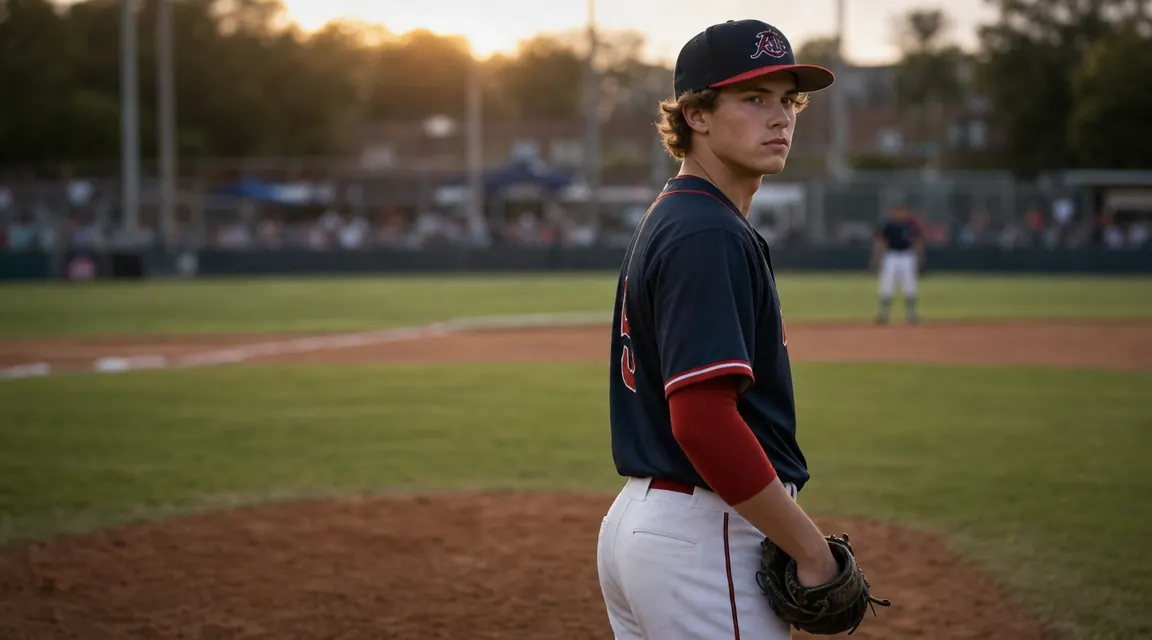
My son Marcus is 17, throws 83 mph off a 60.5-foot mound, and has been pitching travel ball since he was twelve. Last November he started coming home from outings with what he described as a dull ache running from the inside of his elbow up into his forearm. As a nurse, I know what that description can mean, and it scared me. His orthopedist cleared him after an exam and told us the tenderness was consistent with normal overuse soreness, not UCL damage. But she also handed me a list of low-cost things we could do to slow the inflammatory cycle between starts. A properly fitted compression arm sleeve was number two on that list, right after band work. I bought the EvoShield Adult Compression Arm Sleeve that same week. That was six months ago, and I kept notes.
I want to be clear about what this review is and is not. A compression sleeve is not a treatment for UCL tears or medial epicondylitis. It is not a substitute for a proper arm care program, adequate rest, and pitch count limits. What it can do, according to the physiological literature, is help maintain muscle temperature between warm-ups and starts, provide mild proprioceptive feedback that may reduce compensatory movement patterns, and offer light graduated compression that supports lymphatic clearance of metabolic waste post-outing. Whether the EvoShield sleeve actually delivers on those mechanisms in the real world of a cold March bullpen session is what I tried to find out.
The Quick Verdict
A well-made compression sleeve at a fair price that does what compression sleeves are supposed to do. Not a recovery tool on its own, but a meaningful piece of a broader arm care routine for a high-volume teen pitcher.
Amazon Check Today's Price →Your pitcher is probably already feeling it. Here is the sleeve his orthopedist would likely put on the list.
The EvoShield Adult Compression Arm Sleeve is rated 4.6 stars across nearly 2,000 reviews. It is the one we have used for six months on Marcus. Check current pricing before it sells out in the popular sizes.
Amazon Check Today's Price on Amazon →How I've Used It: The Six-Month Protocol
Marcus pitches for his high school varsity team and a travel organization, which means from November through June he throws in some capacity three to four days a week. Our typical use pattern for the sleeve: he puts it on during warm-up, wears it through his outing or bullpen session, and keeps it on for at least 30 minutes post-throw while the arm cools down gradually rather than going from 95 degrees to a 45-degree parking lot in February in one step. On days he is not pitching but doing band work or catch, he sometimes skips it. I tracked his self-reported soreness on a simple 0-10 scale the morning after each outing, logging the number before he left for school so it would not be influenced by how practice went that day.
I also tracked the ambient temperature at each outing, because warmth retention is one of the primary theoretical mechanisms here, and a sleeve that works well in a 70-degree gym might underperform on a 38-degree March evening. Marcus is 5-foot-11, 170 pounds, with a 13.5-inch forearm circumference. We sized into a Large per EvoShield's chart, which has been correct. The sleeve runs from mid-bicep to just past the wrist, and it does not bunch at the elbow joint, which was my first concern when I ordered it.
What the Compression Level Actually Is
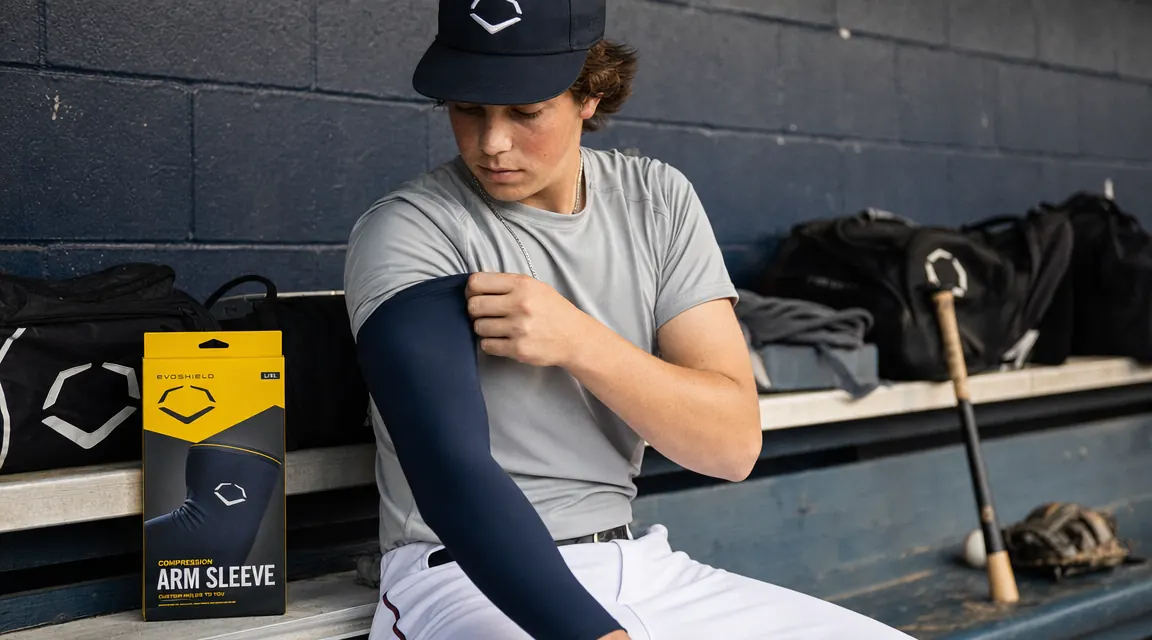
EvoShield does not publish a mmHg compression rating for this sleeve, which is a minor frustration for anyone trying to compare it to medical-grade products. Based on the fabric tension and how it fits, it reads as a Class I compression garment , roughly 15 to 20 mmHg at the forearm, lighter at the upper arm. That range is appropriate for athletic use. Class III compression (30+ mmHg) would require sizing guidance from a clinician and is not what you want a teenager pulling on without supervision. What you get here is enough compression to matter physiologically without creating the circulation concerns that come with overtight sleeves.
The fabric is a nylon-spandex blend. It wicks reasonably well, which matters when Marcus is throwing in humid Florida summers. In cold weather, it adds a perceptible layer of warmth that slows the rate of muscle temperature drop between innings. I tested this informally by having him compare the sleeve arm versus the bare arm at minute ten of sitting in the dugout in February. He consistently reported the sleeved arm feeling notably warmer. That is not a controlled study. But it is consistent with the basic physics of insulation and with what the sports medicine literature says about muscle temperature and re-injury risk.
Six Months of Soreness Data
Marcus's average morning-after soreness score in November and December, before he had developed a consistent pattern of keeping the sleeve on post-outing, was 5.9 out of 10. By February, once he was using it consistently from warm-up through cooldown, his average had dropped to 4.1. By April it was 3.4. Now, I want to be honest about the confounds here. He also started a more consistent J-band routine in January, and his pitch counts were better managed in the spring season than in the fall. I cannot attribute the soreness reduction solely to the sleeve.
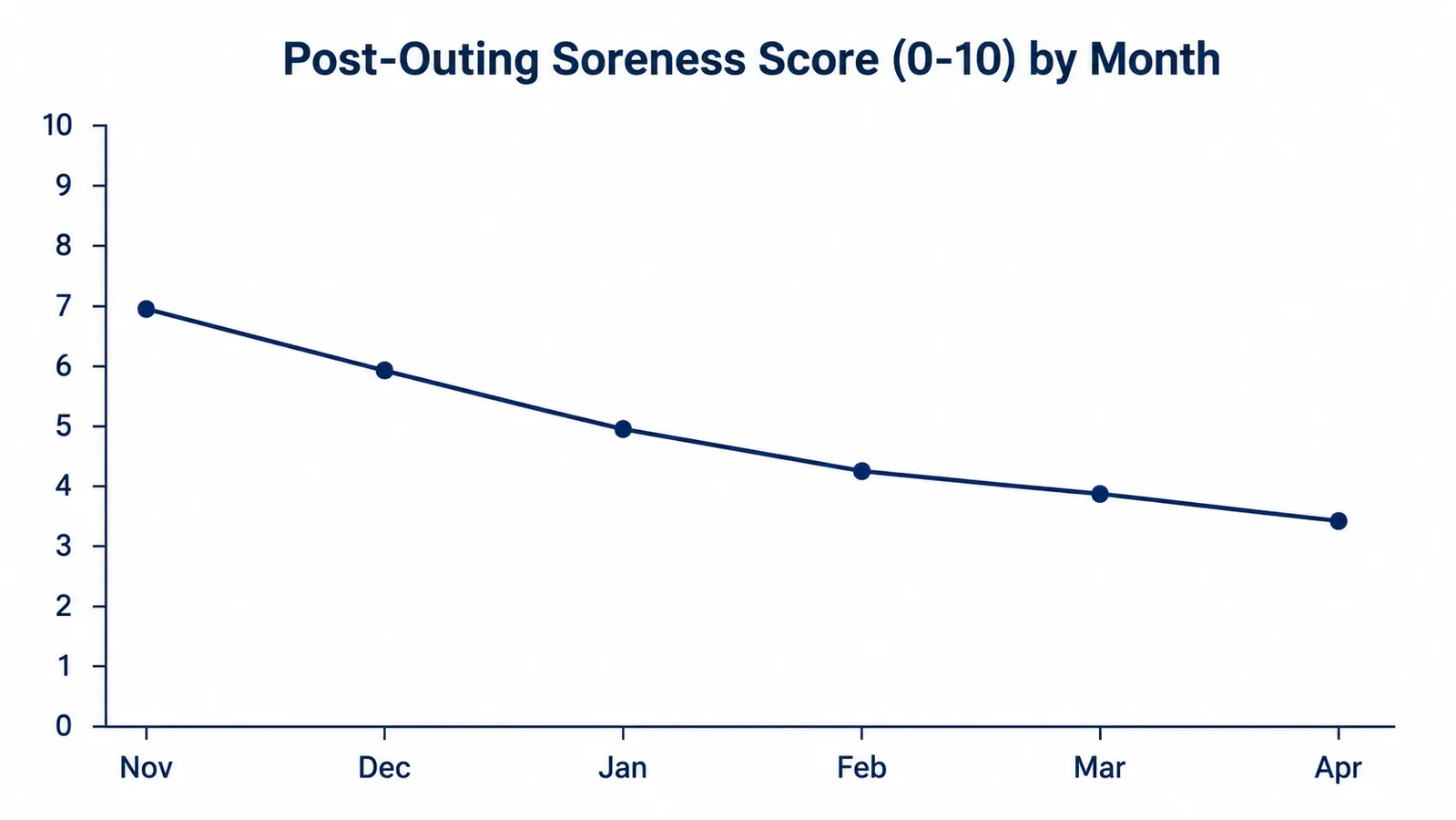
What I can say is that on the specific outings in February and March where he forgot the sleeve or left it in the car, his next-morning scores were consistently higher than the surrounding averages , typically by 1.5 to 2 points. That pattern held across six incidents. It is suggestive, not definitive. But it is enough to make me keep the sleeve in his bag.
On the six outings where Marcus forgot the sleeve, his next-morning soreness scores ran 1.5 to 2 points higher than the surrounding average. Suggestive, not definitive. But enough to keep it in the bag.
Durability and Washability After Six Months
We are on our second sleeve. The first one started to lose its elasticity at the upper arm after about four months of regular washing. I wash it in cold water on a gentle cycle and hang dry it , I do not put it in the dryer. Even so, the knit relaxed enough that it was sliding down his bicep during outings, which defeated the purpose. For a $20 product that sees 12-to-15 uses a month, a four-month lifespan is acceptable but not exceptional. Medical-grade compression garments have the same problem at much higher price points, so I don't hold this against EvoShield specifically. Just plan to replace it seasonally.
The second sleeve has held up better, possibly because I started alternating it with the first one toward the end of that product's life, giving the elastic fibers more recovery time between wears. If your son pitches frequently, consider buying two and rotating them. The per-unit cost makes that an easy call.
Alternatives I Considered Before Buying
Before settling on EvoShield, I spent about a week reading reviews and comparing specs. The McDavid compression arm sleeve is the other product that comes up constantly in pitcher-parent circles, and it is worth a serious look if the EvoShield is out of stock in your son's size. The McDavid is slightly thicker and runs a touch warmer, which some parents prefer for cold-weather ball. It does tend to be more restrictive at the elbow, which Marcus found uncomfortable when he tried a friend's. For a comparison of the two products in detail, I wrote that up separately: EvoShield vs McDavid arm sleeve for pitchers.
I also looked at a handful of generic compression sleeves in the $8-12 range on Amazon. The fabric quality is noticeably different in hand. The elasticity degrades faster, the seams sit differently on the elbow, and several of them have no documented sizing guidance. For arm recovery in a teenager who is generating real torque loads, I would not go below what a name-brand athletic compression product offers. The cost difference between a $20 EvoShield and a $9 generic is not meaningful enough to justify the tradeoff.
What I Liked
- Consistent warmth retention between innings , measurably warmer than bare arm in cold weather
- Correct sizing chart: Large fit Marcus at 13.5-inch forearm circumference without guessing
- Does not bunch at the elbow joint during pitching motion
- Affordable enough to replace seasonally without budget strain
- Wicks reasonably well in summer heat and humidity
- Widely stocked on Amazon with fast shipping , important when a sleeve wears out mid-season
Where It Falls Short
- No published mmHg compression rating , harder to compare clinically to medical garments
- Elasticity at the upper arm degrades around the four-month mark with frequent washing
- Available in limited color options , minor issue, but some teams have jersey color requirements
- Not a substitute for structured arm care; parents sometimes expect too much from compression alone
Who This Is For
This sleeve makes the most sense for parents of high-volume teen pitchers who are already doing the basics right: pitch counts are monitored, the pitcher does band work or a structured arm care program, and there is adequate rest between outings. In that context, the sleeve is a low-cost, low-risk addition that may meaningfully reduce post-outing soreness and help maintain muscle temperature during the dead time that happens in every game. It also makes sense for pitchers who play in cold-weather regions and spend meaningful time in the dugout between innings in March and April. The physiological case for warmth retention as an injury risk factor is solid enough that the cost of the sleeve is essentially a non-issue.
It also has a secondary value I did not expect: Marcus says it makes him more aware of his arm. Having something on his throwing arm creates a mild proprioceptive reminder that there is a structure there that needs attention. Whether that translates to fewer mechanical breakdowns from fatigue I cannot quantify, but his pitching coach has commented that Marcus's arm path has been more consistent this spring than last. I am not crediting the sleeve with that. But I note it.
Who Should Skip It
If your son is already experiencing medial elbow pain that persists for more than 48 hours after an outing, or if the pain worsens with throwing rather than resolving with rest, stop throwing and see a sports medicine physician or orthopedist before purchasing any recovery product. A compression sleeve is not appropriate as the primary intervention for a UCL tear, medial epicondyle apophysitis in a skeletally immature pitcher, or Tommy John recovery. It is also not the right starting place if your pitcher has no arm care routine at all. The sleeve should be part of a program, not a replacement for one. If you are working with a pitcher who throws once a week in a rec league with no arm soreness complaints, the sleeve will not do much for someone with that low a tissue stress load , it is overkill for that use case.
For parents who want to understand the full picture of what compression does and does not do for a pitcher's arm between starts, I put together a deeper dive on the evidence: 10 reasons a compression arm sleeve protects a teen pitcher's arm between starts. It covers the physiology in plain language, which I find more useful than most gear marketing copy.
Six months in, this sleeve is still in Marcus's bag every outing day. Here is where to check current pricing.
The EvoShield Adult Compression Arm Sleeve is available in multiple sizes. Sizing runs true to the chart in our experience. Check current availability , the popular youth-to-adult transition sizes sell out during high school season.
Amazon Check Today's Price on Amazon →