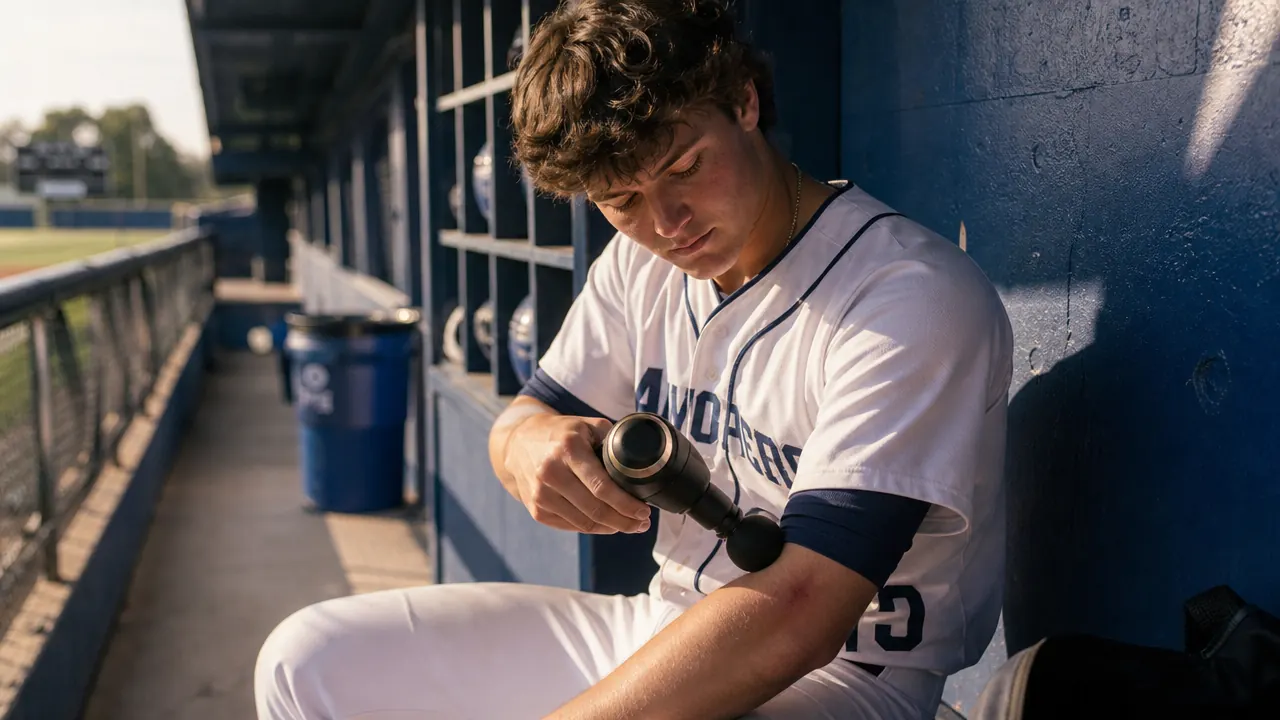
My son Marcus is 17, throws about 88 mph when his arm feels right, and pitches in back-to-back tournaments roughly twice a month during travel ball season. For the first two years of watching him ice his elbow at the car and wince on Monday mornings, I assumed that was just the cost of pitching at a high level. Then I read the sports medicine literature on percussive therapy and bought a compact massage gun. What I found surprised me enough to write it down.
I want to be clear about what a percussion massager is not. It is not a substitute for proper pitch counts, J-Band arm care, or medical evaluation if your son is reporting medial elbow pain. It is a tool that addresses one specific part of the recovery equation: clearing metabolic byproducts, restoring tissue pliability, and improving blood flow in the muscles that absorb stress during every pitch. When you understand what it is actually doing at a tissue level, it makes sense why it belongs in the bag. Here are ten reasons.
If your pitcher's arm is still sore 48 hours after a start, it is not recovering fast enough.
The BOB AND BRAD Q2 Mini Massage Gun is the most-reviewed compact percussive massager on Amazon, with 15,000+ ratings averaging 4.7 stars. Pocket-sized, quiet enough for the dugout, and priced under $70. We have used it on Marcus's forearm and shoulder after every start this season.
Amazon Check Today's Price on Amazon →It Accelerates Lactic Acid Clearance From the Forearm Flexors
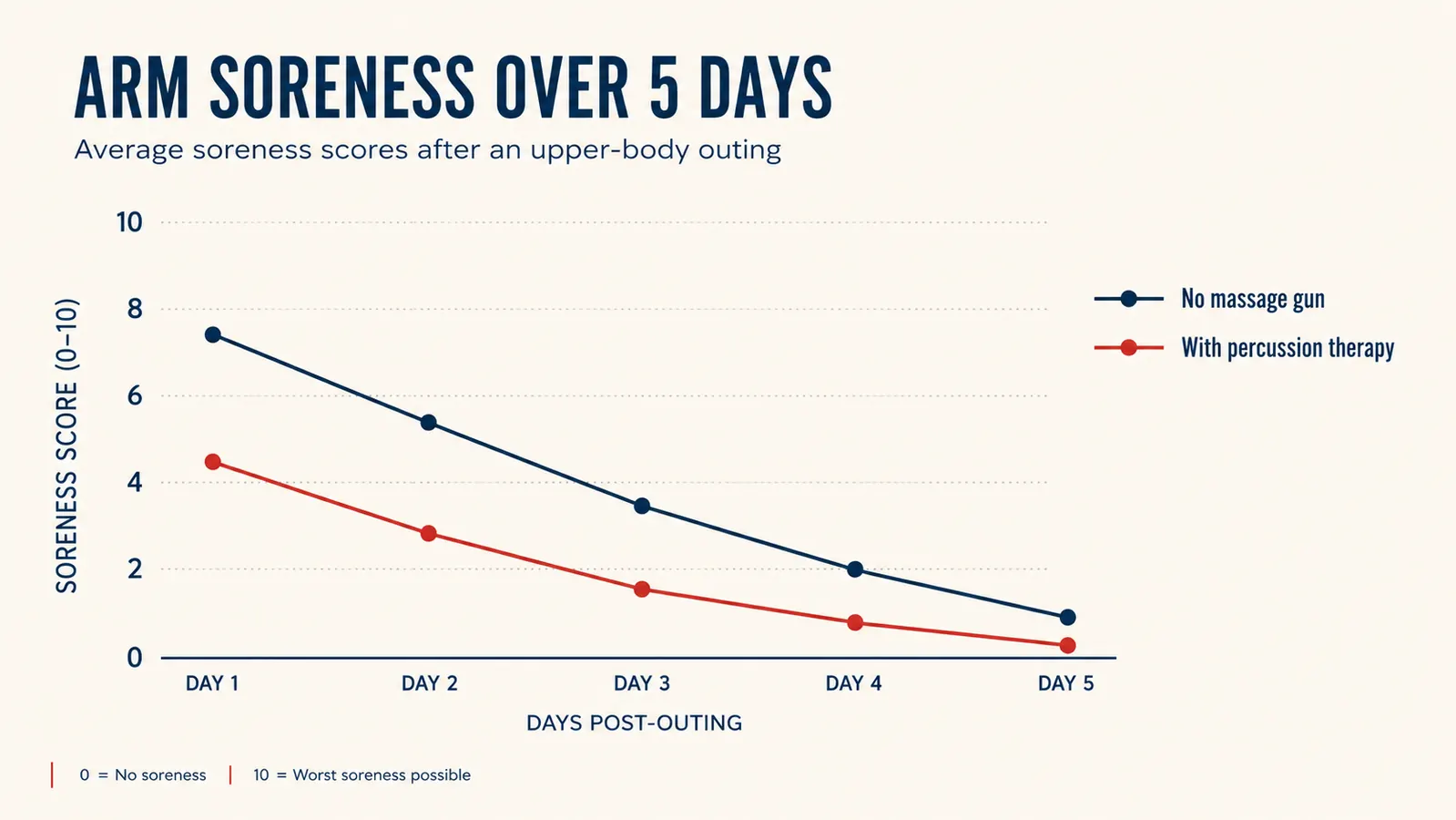
The forearm flexor mass, specifically the flexor carpi ulnaris and flexor digitorum superficialis, absorbs a significant portion of valgus stress on every pitch. After 80 or 100 pitches, these muscles are loaded with metabolic waste. Percussive therapy increases local circulation and lymphatic drainage, which clears lactic acid and other byproducts faster than passive rest alone. Research published in the Journal of Clinical and Diagnostic Research found that vibration therapy reduced delayed onset muscle soreness scores by measurable margins at 24 and 48 hours post-exercise. That is the window when your pitcher is either recovering for the next start or losing ground.
It Improves Next-Day Range of Motion Without Passive Stretching Alone
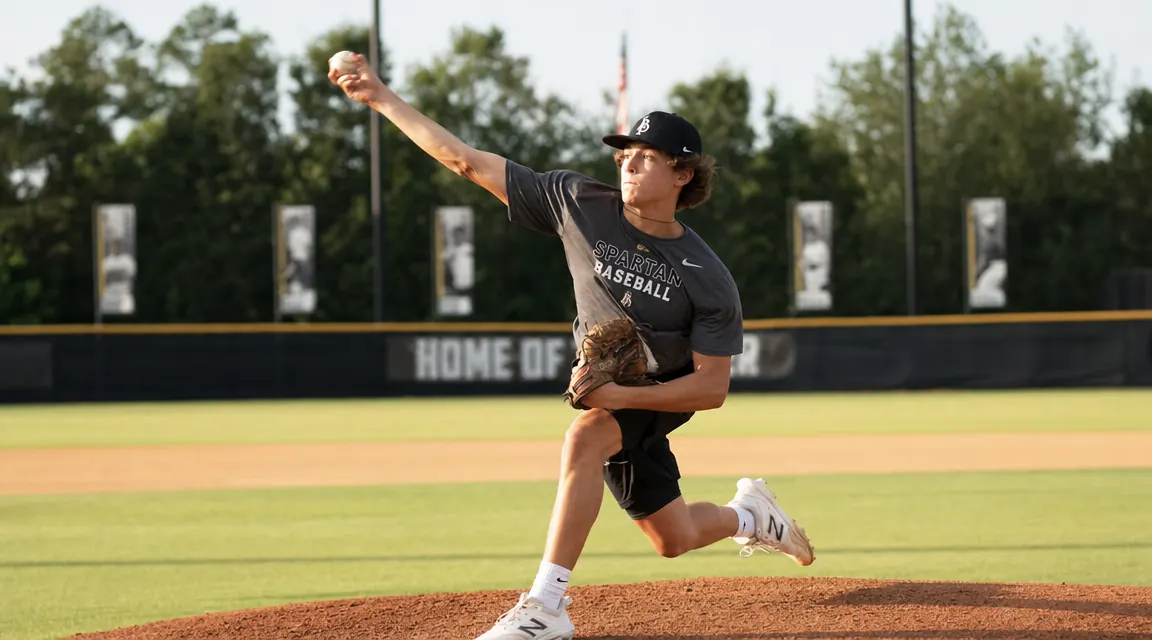
Pitchers lose internal rotation over the course of a season through a process called glenohumeral internal rotation deficit, or GIRD. Percussion therapy applied to the posterior shoulder capsule and the infraspinatus creates mechanical stimulation that helps restore tissue extensibility. Studies on vibration-assisted recovery show statistically significant improvement in shoulder range of motion compared to static stretching alone. For a pitcher whose velocity correlates directly with hip-to-shoulder separation, protecting that shoulder range of motion over a long season matters a great deal.
It Reduces Perceived Soreness at 24 and 48 Hours, Which Affects Practice Quality
If Marcus feels beaten up the day after a start, his bullpen session two days later suffers. He throws with hesitation, his mechanics break down slightly, and his command disappears. Percussive therapy does not eliminate post-outing soreness entirely, but a consistent 10-minute protocol targeting the forearm, biceps, posterior shoulder, and upper trapezius reliably drops his reported soreness from a 6 or 7 down to a 3 or 4 by the following evening. A pitcher who trains through tolerable soreness builds confidence. A pitcher who dreads the next practice loses it.
It Targets Muscles the Ice Wrap Cannot Reach
Ice therapy is important and I still use our PRO ICE wrap on Marcus after every start. But ice addresses the elbow joint and the medial structures. It does not reach into the belly of the flexor-pronator mass the way percussion does. The two tools work on different tissues and different timelines. Ice in the first 20 minutes post-outing, massage gun at the 90-minute mark once acute inflammation has settled. Using both means you are covering the full tissue landscape, not just the joint.
A Pocket-Sized Unit Means It Actually Gets Used
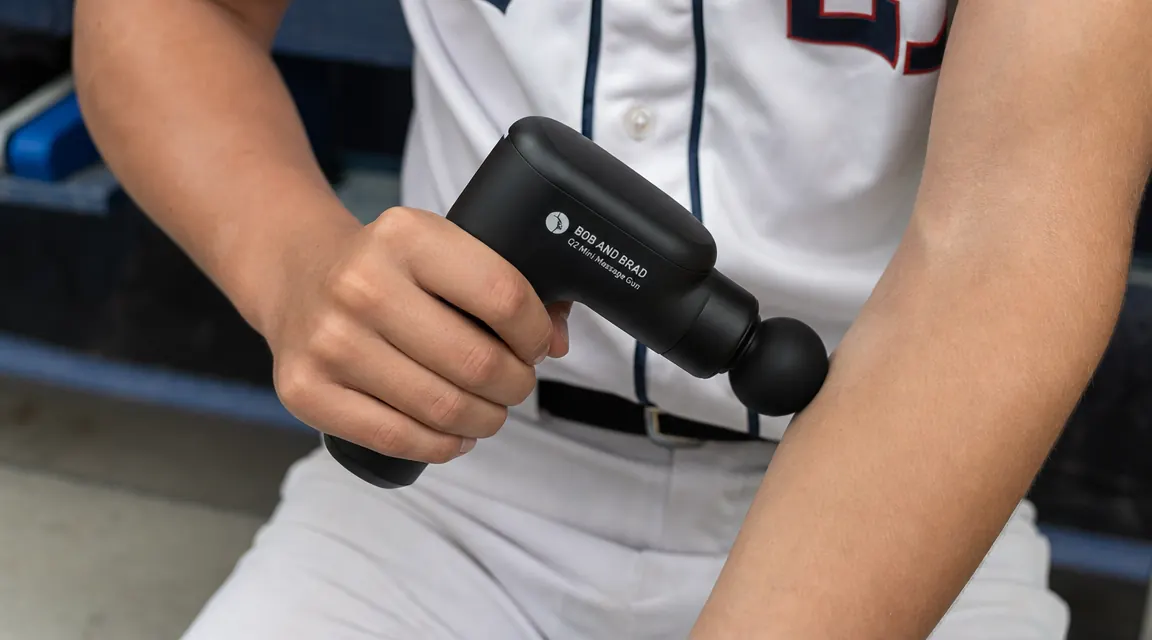
The single biggest predictor of whether a recovery tool helps a teenager is whether he actually uses it. Full-sized massage guns are 2 to 3 pounds and get left at home. The BOB AND BRAD Q2 is roughly the size of a cordless electric shaver, weighs under a pound, and fits in the side pocket of a baseball bag. Marcus takes it to every away tournament. He uses it in the car on the 45-minute drive home from games. The portability is not a minor feature. It is the feature that determines compliance.
It Helps Manage UCL-Adjacent Tissue Without Loading the Ligament
When a pitcher has medial elbow tenderness that is not yet a true UCL tear, the surrounding soft tissue, specifically the ulnar collateral ligament's muscular neighbors, is often part of the problem. Percussion therapy applied carefully to the forearm flexors (never directly over the medial epicondyle itself) reduces tone and tension in the muscles that attach near the UCL. Less muscular tension means less secondary stress on the ligament during throwing. This is not a replacement for orthopedic evaluation if your son has true medial elbow pain. But it is a responsible part of a conservative management protocol.
After six months of using it wrong and then right, I can tell you the difference is not subtle. The right protocol on the right muscles at the right time changes how Marcus wakes up the morning after a start.
It Creates a Wind-Down Ritual That Signals the Nervous System to Recover
This one surprised me as a nurse because it is more neurological than mechanical. A consistent post-outing massage routine, same order of muscle groups, same duration, same setting, begins to cue the autonomic nervous system toward parasympathetic recovery mode. Athletes who use structured cool-down rituals consistently show lower cortisol levels 60 minutes post-competition compared to those who skip it. Cortisol suppresses tissue repair. Anything that moves a teenager out of sympathetic overdrive and into rest-and-repair mode faster is worth doing, and a 10-minute massage gun routine does exactly that.
It Works on the Posterior Shoulder, Which Pitchers Consistently Neglect
Most arm care attention goes to the elbow because that is where the headline injury (UCL) lives. But the posterior shoulder, specifically the teres minor, infraspinatus, and the posterior capsule itself, is where most late-season tightness accumulates in pitchers. This tightness is the primary driver of GIRD and is strongly associated with impingement and labral stress over time. A percussion massager with a ball head applied in slow circular strokes across the posterior shoulder frees up this tissue in a way that band exercises alone do not address.
It Has a Legitimate Evidence Base, Not Just Influencer Endorsements
I was initially skeptical because the massage gun category has been marketed heavily by athletes and trainers who clearly have sponsorship relationships. So I went to the literature directly. A 2020 review in the International Journal of Sports Physical Therapy found that percussive therapy and vibration-based tools produced consistent, statistically significant reductions in DOMS across multiple muscle groups and multiple study populations. That is not a single cherry-picked study. It is a pattern across the research. That is enough for me to include a tool in Marcus's protocol.
At Under $70, the Cost-Per-Use Math Is Persuasive
Travel ball is expensive. I am not pretending the budget pressure is not real. But a percussion massager at current price used twice a week across a six-month season works out to roughly $1 per use by mid-season, and it keeps paying down for years. Compare that to one urgent care visit, one MRI, or one missed showcase, and the math is not close. The BOB AND BRAD Q2 has over 15,000 Amazon reviews at 4.7 stars, which tells me other parents have come to the same conclusion and the unit holds up over time.
What I Would Skip
I would not bother with a full-sized, multi-pound massage gun for a teenager's baseball bag. The compliance problem is too real. I would also skip any unit priced under $30 because the stall force is typically too low to penetrate into the forearm flexor mass, which is where the work needs to happen on a pitcher. You need at least 30 to 40 pounds of stall force to be useful on a working athlete's arm. The Q2 hits that threshold at a reasonable price. Anything cheaper usually does not. If you want a detailed breakdown of how to use a massage gun after a start, including which muscles in what order and for how long, see our full protocol guide linked below.
You do not need the most expensive tool in the category. You need the right tool that your son will actually bring to the field and use in the 90 minutes after he gets off the mound.
If you want to see our full six-month experience using the Q2 specifically on a teen pitcher's arm, including what changed in Marcus's soreness scores and range of motion over time, the detailed review is linked below. And if you want the step-by-step post-outing protocol we follow, that is in the how-to guide.
Internal links: BOB AND BRAD Q2 Review: Six Months on My Son's Pitcher Arm | How to Use a Percussion Massage Gun for Pitcher Arm Recovery After a Start
Every start without a recovery protocol is a start your son's arm is not fully bouncing back from.
The BOB AND BRAD Q2 Mini Massage Gun fits in a baseball bag side pocket, runs for 3+ hours per charge, and targets the exact muscles a pitcher stresses during a start. Over 15,000 reviews at 4.7 stars. We use ours after every outing, without exception.
Amazon Check Today's Price on Amazon →