

I am a nurse. I read product instructions. I watched the tutorial videos. I thought I knew what I was doing when I bought the BOB AND BRAD Q2 for my son Marcus, who is 17 and throws about 85 pitches per outing for his high school team. I was wrong about three things that mattered, and in the first two weeks I almost certainly made the delayed-onset muscle soreness in his forearm worse, not better. That is what this review is actually about.
If you want a breakdown of how the Q2 performs over six months of daily use, how it compares to the Theragun Mini on stall force and battery life, or what the hardware is actually like, read the companion piece on this site. This article is specifically about the things nobody warns pitcher parents about before they turn on a percussion massager and run it over their kid's throwing arm for the first time.
The Quick Verdict
Genuinely useful recovery tool for teen pitchers, but the timing rules are non-negotiable and the forearm attachment head they ship as default is the wrong choice for the flexor mass.
Amazon Check Today's Price →Your pitcher's forearm muscles can be flushed or further irritated depending on one variable: when you use this.
The BOB AND BRAD Q2 is the best-priced percussion massager that has enough stall force to actually reach the deeper forearm flexors. Check the current price before you buy the wrong one.
Amazon Check Today's Price on Amazon →The Mistake I Made in Week One (and Why It Felt Logical)
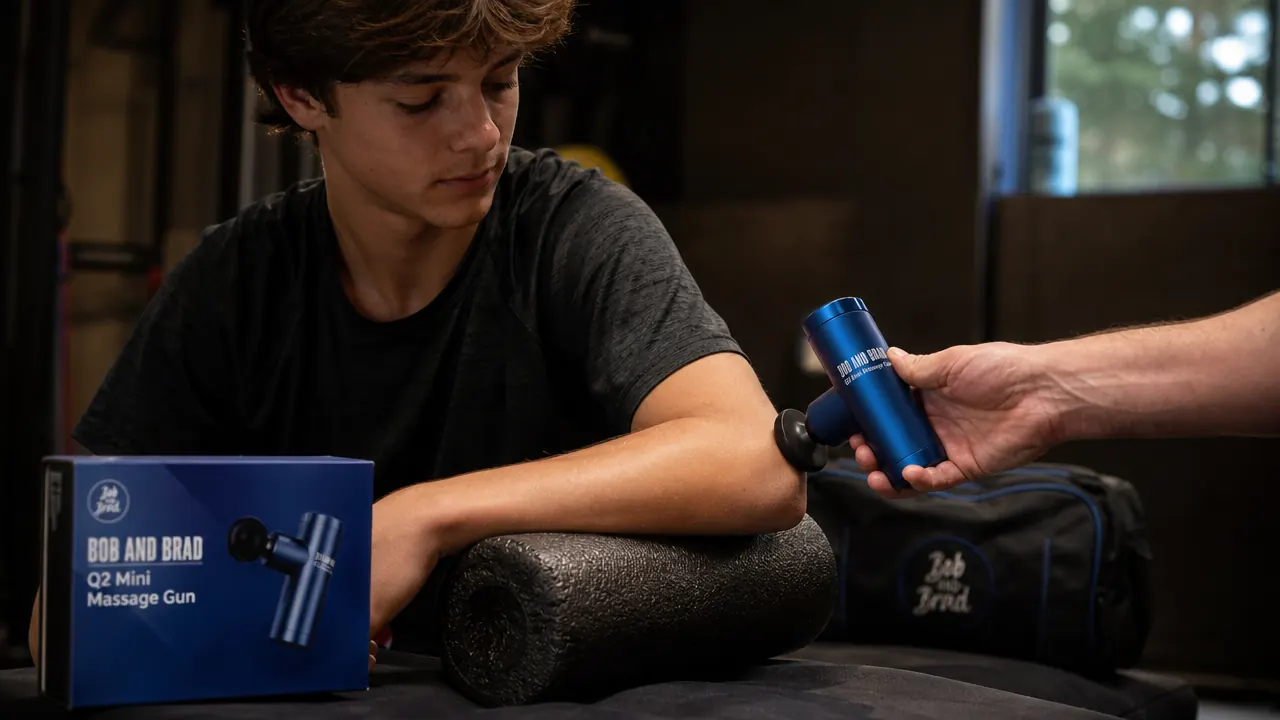
Marcus pitches on Saturdays. By Sunday morning, his right forearm is predictably sore, usually right along the medial side between the wrist and elbow, in the flexor-pronator mass where all those overhand throws accumulate stress. I figured: percussion massage increases blood flow, blood flow accelerates recovery, therefore I should use the Q2 as soon as possible after the outing. I used it the same night he pitched. Within about 30 to 40 minutes of him coming off the mound.
That is the wrong window. Not catastrophically wrong, but wrong in a way that matters for a young pitcher's arm. Here is the tissue-level problem: the micro-trauma from high-velocity throwing causes a low-grade acute inflammatory response in the muscle fibers and connective tissue, and that response is part of the repair process. Running a percussion massager directly over the affected area within the first two hours of a hard outing interrupts that response prematurely and can actually delay tissue repair rather than accelerate it. The correct window for percussion massage on an acutely worked muscle is at least four to six hours post-activity, and many sports medicine PTs recommend waiting until the next morning entirely.
The BOB AND BRAD product page does not say any of this. The included quick-start card does not say it. You have to either already know it from clinical training, or stumble across it in the research yourself. I found it in a 2021 study out of the Journal of Strength and Conditioning Research that compared delayed application versus immediate application of vibration therapy on exercise-induced muscle damage. The difference in recovery markers at 48 hours was meaningful.
The Area You Should Not Use It On (No Matter What the Videos Show)
Search for 'massage gun forearm pitcher' on YouTube and you will find a dozen coaching and sports performance accounts running the device right along the medial elbow. That is the zone I want you to avoid on a teen pitcher, especially any pitcher who has had elbow soreness evaluated, who has mentioned medial pain during or after throwing, or who is in that gray zone of UCL stress that does not yet require surgery but has shown up on imaging.
The ulnar nerve runs through the cubital tunnel at the medial elbow, and it sits close to the surface. Percussion therapy directly over that area can cause temporary ulnar nerve irritation, which presents as tingling down into the ring and pinky finger, a buzzing sensation in the elbow, or transient numbness. In a healthy adult athlete this is usually minor. In a 17-year-old whose medial elbow is already under load from a competitive pitching season, it is not a risk worth taking. The safe application zone for the forearm flexors starts about two finger-widths distal to the medial epicondyle, which is the bony bump on the inside of the elbow. That is where the muscle belly begins. That is where the Q2 should go.
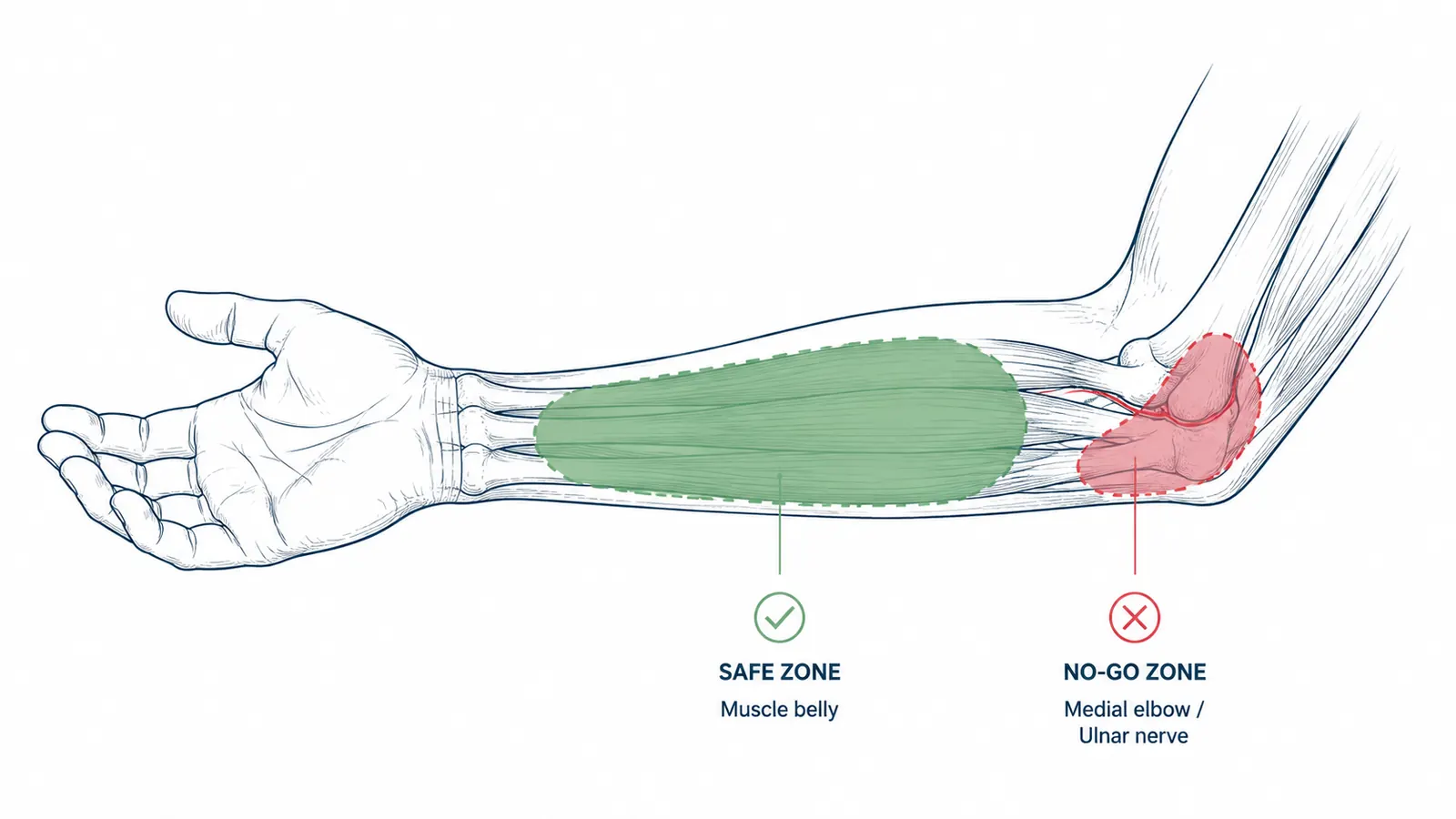
The diagram above reflects what a sports medicine physical therapist walked me through when I described how I had been using the device. The green zone is where percussion therapy is appropriate: the muscle belly of the flexor-pronator group and the long belly of the brachioradialis on the outer forearm. The red zone, the medial epicondyle itself and the inch immediately surrounding it, should be completely avoided with a percussion device in a pitcher with any history of medial elbow complaints.
The Attachment Head Problem Nobody Mentions
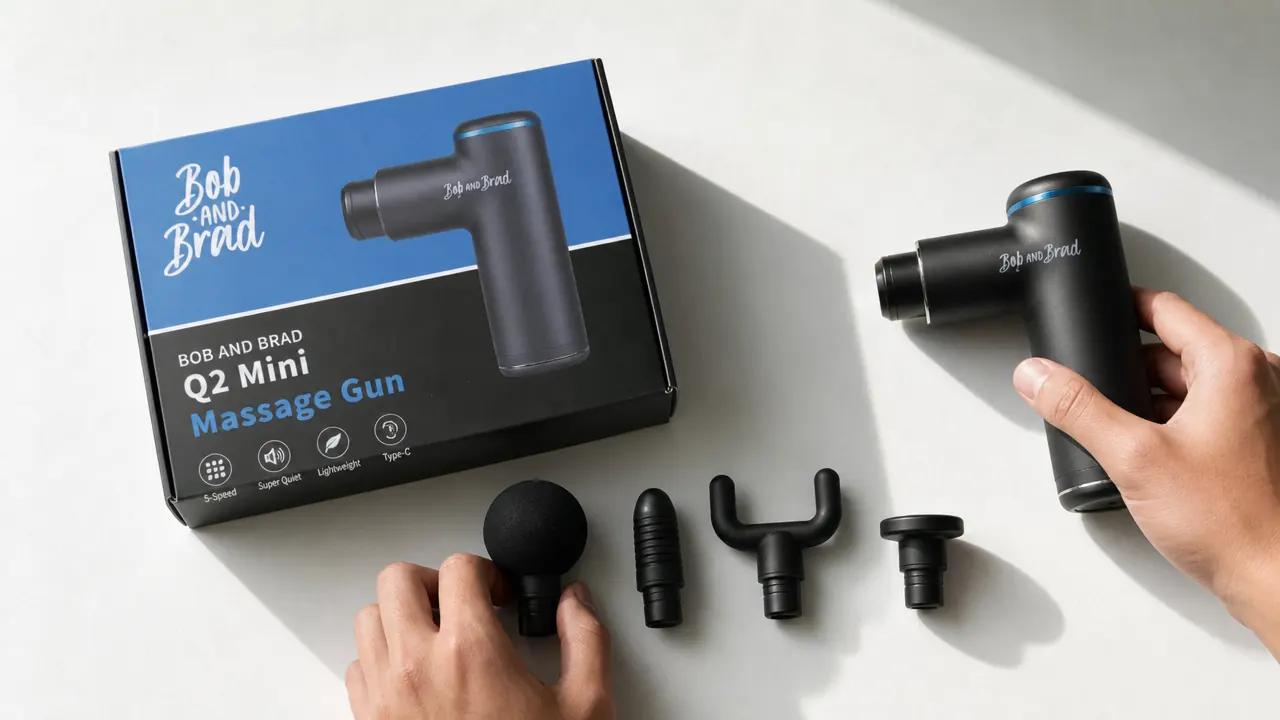
The Q2 ships with four heads. The round ball head is loaded by default when you take it out of the box, and it is the head most of the tutorial content uses. For the forearm, it is the wrong choice. The ball head disperses force across a wide surface area, which feels fine on a large muscle group like the quads. On the forearm flexors, which are a narrow, cord-like group of muscles packed close together, you want the flat head or the bullet head for targeted penetration. The ball head on the forearm produces a diffuse vibration effect that is more superficial than percussive. You will feel like it is working because the sensation is noticeable, but the force is not reaching the deeper fibers.
I switched to the flat head for Marcus's forearm work after learning this from a certified athletic trainer who works with a local high school sports program. The difference in his feedback was immediate. He described the flat head as actually feeling like it was getting into the soreness rather than just vibrating the surface. That subjective report lines up with the biomechanics: a smaller contact surface concentrates the same amplitude of force into a smaller area, which increases tissue penetration depth.
The round ball head is loaded by default. For a pitcher's forearm, it is the wrong head. Switching to the flat head was the single change that made the Q2 actually feel like it was working.
Speed Setting: Lower Is Not Just Gentler, It Is Different
The Q2 has three speed settings: 1800, 2400, and 3200 percussions per minute. The instinct as a parent is to start low and work up, which is reasonable. But there is a more important distinction that the product does not explain: low-frequency percussion (the 1800 setting) is better for flushing metabolic byproducts out of a muscle after exercise, while the higher settings are better for breaking up adhesions and working on chronic tightness. For post-outing recovery use on Marcus's forearm, the right call is always the 1800 setting. We only go to the 2400 setting on non-pitch days when we are working on general tightness, and we have never used the 3200 setting on his throwing arm at all.
Running the highest setting on an acutely sore forearm flexor does not help it recover faster. It increases local tissue stimulation to a point where it can actually prolong the soreness window rather than shorten it. This is the same reason a sports massage therapist will use light effleurage strokes immediately after exercise rather than deep tissue work. The tissue needs circulatory flush, not structural intervention, in the acute recovery window.
What the Product Does Very Well (and Why I Still Recommend It)
Once I corrected those three things, the timing, the zone, and the attachment head, the Q2 became genuinely useful. The noise level is low enough that Marcus uses it in the car on the way home from road games without it being disruptive. The battery lasts through a full week of daily 10-minute sessions before it needs a charge, which matters because if charging becomes a chore, a 17-year-old will stop using the device entirely. The stall force at the 2400 setting is sufficient to get real tissue work done even through light clothing, which means he can use it without having to undress in a dugout or a team van.
At this price point, there is no other percussion massager that offers the same combination of portability and meaningful stall force. I have read the research that compares the Q2 to clinical-grade devices, and yes, the higher-end tools have better amplitude and more consistency under load. But for a teen pitcher doing 10-minute forearm and shoulder recovery sessions, the Q2 delivers the physiological effect we need. We are not doing fascia release work here. We are moving metabolic waste out of muscle tissue and keeping the arm loose between starts.
The Shoulder Protocol Is Different From the Forearm Protocol
Marcus's shoulder gets the Q2 on a different schedule than his forearm. The posterior shoulder capsule, specifically the external rotators and the posterior deltoid, tends to tighten after a hard outing in a way that is less acute than the forearm soreness. He gets about four to five minutes on the rear shoulder using the ball head, starting 12 to 24 hours post-outing, and I am more liberal about the speed setting here because the musculature is larger and less vulnerable. The rotator cuff tendons themselves are off-limits. We are working on the muscle bellies only, staying well clear of the acromion and the acromioclavicular joint.
I want to be direct about this: if your pitcher has ever been told they have rotator cuff impingement, a SLAP tear, or any labral issue, you should clear percussion massage protocol with their sports medicine provider before using a massage gun anywhere near the shoulder at all. The Q2 at 3200 RPM over an inflamed subacromial space is not something you want to experiment with without clinical guidance. For a healthy shoulder with normal post-outing tightness, it is fine.
What I Liked
- Compact enough to fit in a baseball bag and use in the car without awkwardness
- Battery life holds up across a full week of daily use without mid-week charging
- Stall force at the middle speed setting is sufficient for real forearm flexor work
- Low noise profile at the 1800 setting, low enough for shared spaces
- Four attachment heads included, and the flat head is legitimately useful once you learn which to use
- Price is significantly lower than clinical alternatives with a small fraction of the functional gap
Where It Falls Short
- No usage guidance in the box for sport-specific application, including the timing and zone rules that matter most for young pitchers
- The default loaded attachment head (ball) is the wrong choice for forearm work
- The carrying case feels fragile and the zipper started to fray around the four-month mark
- No auto-shutoff feature, so an unattended teen can easily overwork a sore spot
Who This Is For
The Q2 is the right tool for parents who are willing to learn a small number of non-obvious usage rules before handing it to their pitcher. If you are the kind of parent who reads the clinical context behind a product, or you have 20 minutes to read an article like this one before using it, the Q2 will serve your pitcher well. It is priced accessibly, it works mechanically, and the portability for travel ball families is a genuine practical advantage.
Who Should Skip It
Skip the Q2 if your son or daughter has active medial elbow pain, any diagnosed UCL pathology, or recent imaging that showed structural findings. In those cases, any percussion massager should be cleared by the treating sports medicine physician or physical therapist before use. The Q2 is a recovery tool for healthy arms under normal training load, not a therapeutic device for injured tissue. I also would not hand this device to a pitcher under 14 without being in the room and supervising the session. The instinct to press harder and go longer is common in younger athletes, and that instinct will cause problems on a forearm that is still developing.
If you have read this far, you already know more about using this device correctly than most parents who buy it.
The BOB AND BRAD Q2 is the recovery tool we use in our house after Marcus pitches, following the timing and zone rules described in this review. Check today's price on Amazon and see whether it fits your recovery budget.
Amazon Check Today's Price on Amazon →