
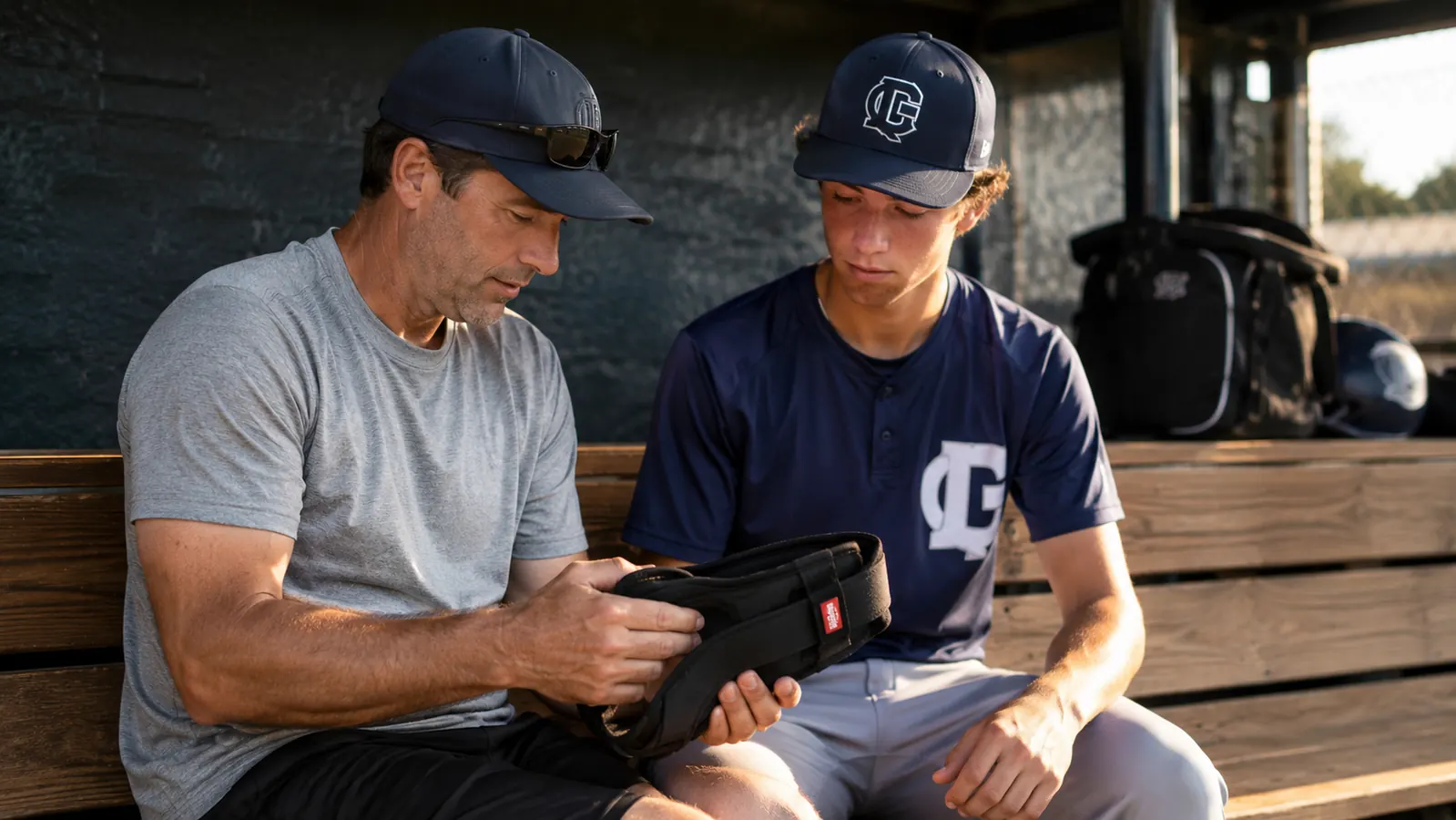
When my son Marcus started favoring his throwing arm after outings last spring, I did what most parents do: I went online and searched for an elbow brace for pitchers. We eventually landed on the McDavid elastic elbow support, and the framework below is how I would tell another parent to make the same decision. What I found was a wall of options with no clear guidance on which type does what or why. Compression sleeves. Epicondyle straps. Hinged ROM braces. Neoprene wraps. All of them claim to protect the elbow. None of the product listings tell you the one thing that actually matters: which type fits the injury pattern or prevention goal your specific kid has.
I am a nurse, and I approached this the same way I approach any clinical question. What is the mechanism of stress? What tissue needs support? What does the brace actually do at a physiological level? After talking to Marcus's orthopedic PA, doing my own research, and going through two wrong purchases before landing on the right one, I put this guide together so you can skip that process. We are going to go through the decision step by step, starting with anatomy and ending with a specific recommendation for the most common teen pitcher scenario.
If your teen pitcher needs basic UCL support and compression right now, the McDavid Elastic Elbow Support is where most parents land.
It fits under a jersey sleeve, provides consistent medial compression, and costs less than a single copay. Rated 4.5 stars from over 1,500 verified buyers. Check today's price and sizing chart before the next start.
Amazon Check Today's Price on Amazon →Step 1: Understand What Part of the Elbow Is at Risk for Pitchers
Before you can match a brace to a need, you need to know what you are protecting. For baseball pitchers, the primary risk structure is the ulnar collateral ligament, which runs along the medial (inside) aspect of the elbow. Every pitch places a valgus stress load on that ligament. In adults this stress accumulates over years. In adolescents, the growth plates around the medial epicondyle create an additional vulnerability because the bone itself can be stressed before the ligament fails. This is why little league elbow and UCL sprains present differently in a 14-year-old versus a 25-year-old. The medial side is where you need support.
The lateral (outer) elbow and posterior (back) compartment can also be involved in pitchers, especially if there is hyperextension or cubital tunnel irritation, but these are secondary concerns for most teen pitchers. When a parent asks me which brace to buy, my first question is always: where exactly does the arm hurt, and when does it hurt? Medial pain during or after pitching points you directly toward UCL-protective compression. Pain that shows up during fielding or batting but not pitching may indicate a different structure and a different brace type.
Step 2: Know the Three Brace Types and What Each One Actually Does
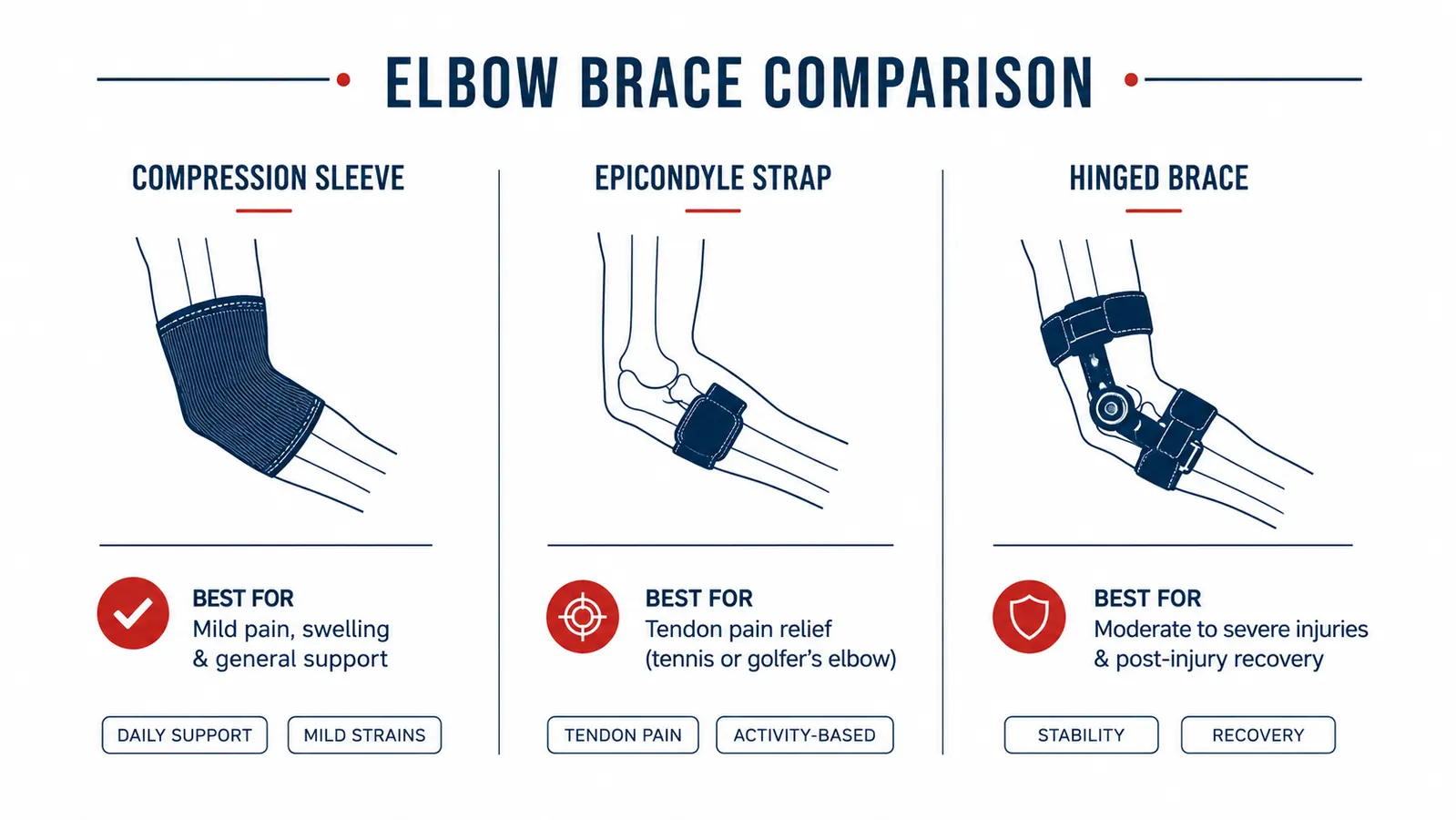
The elbow brace category has three meaningfully different product families, and each one works through a different mechanism. Getting this wrong is the most common mistake parents make, because the marketing language overlaps significantly and all three products are shelved together online.
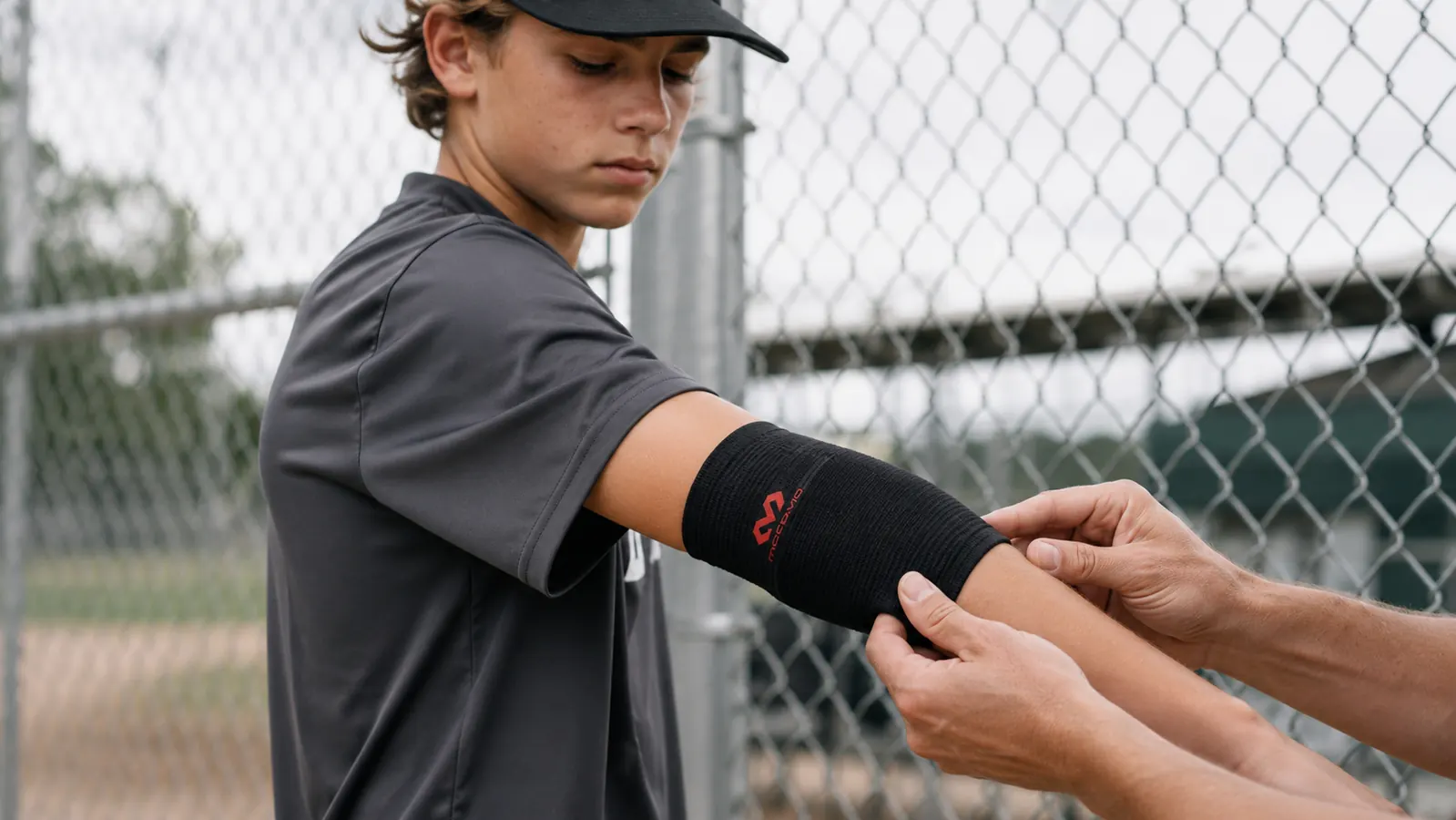
A compression sleeve applies circumferential pressure to the entire elbow joint. It improves proprioception (your brain's sense of where the joint is in space), retains warmth to keep soft tissue pliable, and provides mild structural support against excessive valgus load. This is the right choice for prevention, early-stage UCL stress, and warm-up/warm-down use during a game or tournament. The McDavid Elastic Elbow Support falls into this category. It is the most versatile option for pitchers because it works both during warm-up and while sitting in the dugout between innings.
An epicondyle strap is the tennis elbow band, the narrow strap that sits just below the elbow. It offloads the forearm flexor tendons by changing the angle at which they pull on the medial or lateral epicondyle. This is appropriate for epicondylitis, medial or lateral, but it does not protect the UCL and does not provide joint warmth. Many parents buy this by mistake thinking it is a general elbow brace. For pitchers with UCL stress or UCL sprain history, an epicondyle strap is not the right choice as the primary support.
A hinged range-of-motion brace has bilateral metal or rigid polymer stays that limit how far the elbow can flex or extend. These are prescribed after UCL reconstruction (Tommy John surgery) to protect the graft during the early healing phase. They are medically indicated, expensive, and unnecessary for prevention or mild UCL stress management. If your son's orthopedist has prescribed one, follow that prescription exactly. If you are buying without a prescription for a pitcher without post-surgical hardware, a hinged brace is overkill and the wrong tool.
Step 3: Match the Brace Type to the Specific Situation
Now that you know the three families, here is the decision tree I use. If your pitcher has no current pain and you are buying for prevention during high-volume throwing seasons, a compression sleeve is the right choice. It keeps the joint warm between innings, supports proprioception during warm-ups, and is low-profile enough to wear under a uniform. If your pitcher has medial elbow soreness that starts during outings or lingers the next day, and an orthopedist or PA has cleared him to continue throwing, a compression sleeve with stronger medial support is still the primary tool. If your pitcher has active UCL laxity confirmed by MRI and has been cleared for continued activity (not post-surgical), ask the orthopedist specifically whether a rigid hinged brace or an extended compression sleeve is warranted. Do not make that call yourself.
For the vast majority of parents reading this, the answer lands in the compression sleeve category. The McDavid Elastic Elbow Support is the product we ended up with after working through this decision with Marcus's PA. It hits a 15-20 mmHg compression range, which is enough to make a measurable difference in proprioceptive feedback without restricting the elbow arc he needs to throw comfortably. I have seen it compared unfavorably to higher-end sport-specific sleeves at twice the price, but after six months I have not seen a clinical argument for spending more on a compression sleeve when the mechanism of benefit is the same.
Step 4: Size It Correctly Because an Ill-Fitting Sleeve Does Harm as Well as Good
This step trips up almost every parent buying their first elbow brace online. A compression sleeve that is too loose provides no meaningful compression and becomes a placebo. A sleeve that is too tight can restrict venous return, cause distal swelling, and actually increase soreness in the forearm flexors. Measure your son's elbow circumference at the joint line (not the bicep, not the forearm) with a flexible measuring tape. Do this when the arm is relaxed and slightly flexed, about 15 to 20 degrees. That measurement is the number you look up on the sizing chart, which for the McDavid is printed on the packaging and available on the product listing.
Marcus measures 11.5 inches at the elbow joint and wears a medium. When I first bought the wrong size by going off his height, the sleeve bunched below the epicondyle and provided zero medial support. One exchange later and it was fitting correctly. The sleeve should feel snug without creating a pressure ridge at either edge. If you can slide two fingers comfortably under the top cuff, it is too loose. If the skin is turning pink within five minutes of wear, it is too tight. Both situations require a size change, not an adjustment to how he throws.
Step 5: Build the Brace Into a Consistent Protocol, Not a One-Time Purchase
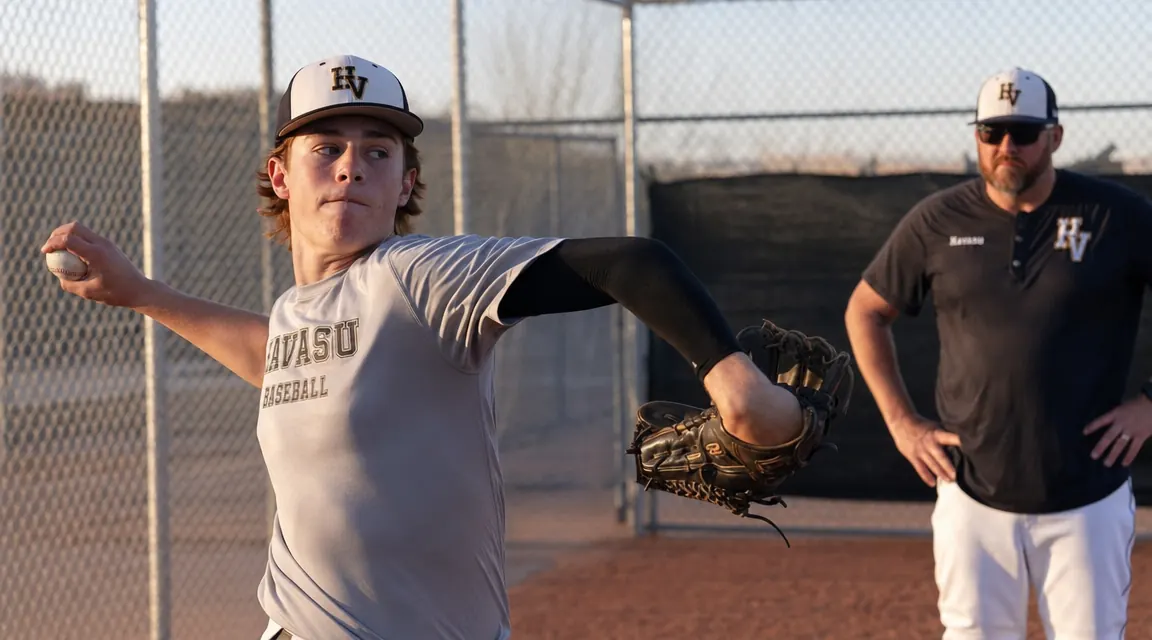
An elbow brace is a recovery and prevention tool, and like any tool it only works when it is used consistently and correctly. The protocol Marcus follows, which his PA helped us develop, has three phases. Pre-outing: sleeve goes on 15 to 20 minutes before the start of warm-up throws, not at the first pitch. The tissue needs time to respond to the compression and begin retaining warmth. Mid-outing: the sleeve stays on between innings whenever he is not actively fielding or at bat. The largest thermal drop in a pitcher's elbow happens during those five to eight minutes sitting in the dugout, and keeping the sleeve on during that window is worth more than wearing it during the actual pitching.
Post-outing: the sleeve comes off after the game once he has done his light band work and his arm has cooled naturally. We then apply a cold therapy wrap over the elbow for 15 minutes, which is a different tool doing a different job. The sleeve's work is done by the time the ice comes out. Washing matters too. The McDavid sleeve is machine washable but it needs to air dry. One round in the dryer will degrade the elastic compression significantly, and a stretched-out sleeve is no longer doing its job. We bought two so there is always one clean and ready.
What Else Helps
A compression elbow sleeve is one layer of a multi-tool approach to elbow health for teen pitchers. The research on UCL injury prevention points consistently to three other variables: pitch count discipline, shoulder and forearm strength work, and post-outing recovery protocol. The sleeve supports all three but cannot substitute for any of them. If Marcus is throwing more than 80 pitches in a high school game with less than four days of rest, no sleeve compensates for that load. If his forearm flexors and pronators are undertrained relative to his fastball velocity, the UCL absorbs mechanical forces it was not designed to handle, and no amount of compression changes that equation. The sleeve is the last line of defense, not the first.
For the arm care work itself, we use Jaeger J-Bands daily for rotator cuff and scapular stabilizer activation. For post-outing recovery, a percussion massage gun on the forearm flexors before ice has made a measurable difference in how his arm feels 48 hours out. These tools are covered in more detail in the related articles below. If you are reading this guide while putting together a complete arm care kit for your pitcher, start with the brace, then layer in the other pieces. One good tool used correctly beats three mediocre tools used occasionally.
The sleeve's job is to keep the joint warm between innings and give the elbow proprioceptive feedback during the throwing motion. It cannot do either of those things if it is sitting in the bottom of the gear bag.
The McDavid Elastic Elbow Support is the compression sleeve we chose after working through this decision with an orthopedic PA. Correct sizing and consistent use are what make it work.
It fits under a uniform, washes easily, and provides the medial compression that matters most for UCL protection during high-volume throwing seasons. Check sizing, availability, and today's price before your son's next start.
Amazon Check Today's Price on Amazon →